a pay uplift that is at least RPI + 3.5% or £2,500, whichever is the higher, on all pay points,
joint action to protect national agreements relating to terms and conditions of employment, and
a national agreement to avoid redundancies, course closures, and cuts to academic disciplines across the sector.
On this page are GTVO resources for reps and activists for this campaign.
The ballot and GTVO
Every UCU member working for a JNCHES employer is being asked to vote. The ballot is ‘aggregated’, that is, all ballots are counted together. This means that if we get a valid mandate, every union member, every branch balloted, will be able to take action together. No-one will be left behind.
But it also means trade union reps have to campaign for every vote. Thanks to the Tory Anti-Union Law, 50% of the entire balloted constituency must participate in the ballot. This anti-democratic measure is still imposed on trade unions over a year after Labour was elected promising its repeal. Before we can take any action over jobs or pay, we need a ‘Get the Vote Out’ campaign organised by grassroots union reps to convince members to vote.
There is unity across the trade unions. The EIS is also balloting its members in JNCHES universities in Scotland. UNITE and UNISON branches are being individually balloted. The unions are coordinating their ballots to start on 20 October, with UNITE ending slightly later. GMB sends its solidarity to the other trade unions: it is in dispute but not yet balloting.
This campaign is a joint one.
Watch: Organising to Get The Vote Out in your branch
a pay uplift that is at least RPI + 3.5% or £2,500, whichever is the higher, on all pay points,
joint action to protect national agreements relating to terms and conditions of employment, and
a national agreement to avoid redundancies, course closures, and cuts to academic disciplines across the sector.
Below are campaigning resources for reps and activists. See also GTVO resources.
Ten Reasons to Vote YES
1. It is a vote against pay and job cuts
A YES vote strengthens the hand of your elected negotiators and your union in the face of a set of employers making massive cuts in pay and jobs.
Over the last two years, in the absence of a national ballot mandate, university employers have imposed real-terms pay cuts and made mass redundancies across the sector.
The government has sat on its hands. It has let the market rip, setting university against university, course against course and colleague against colleague. The latest White Paper continues with more of the same, increasing home student fees and targeting overseas students.
If you don’t vote, or vote NO, you are voting for the status quo, i.e. ever-decreasing real-terms pay and working conditions, together with ever-increasing casualisation, insecurity, redundancies, and, thereby, growing workloads for those who remain in employment.
But we cannot stop a generalised attack on our sector by behaving as if local attacks are just a series of exceptions, and Dundee University management has now returned with the same job cut demand.
We need a UK-wide agreement to stop redundancies.
Shouldn’t the union concentrate on local disputes against redundancies?
Since the beginning of the pandemic, the pattern of local employers attempting to push through redundancies or wholesale course closures or other major attacks on conditions has been very stark. It is when we do not have a mandate for UK-wide industrial action that the local attacks occur.
There was a major rash of job losses after the end of the 2019-20 dispute (most notably Liverpool and Leicester 2021 disputes, but really nationwide during the early months of the pandemic). As soon as only a minority of branches passed the threshold in the summer of 2022, there were major attacks on jobs in Roehampton, Wolverhampton, and several more. Since the end of the 2023 dispute there has been successive waves of job losses, starting at Oxford Brookes, Aberdeen and Staffordshire to the present.
The situation is now that big job cuts are everywhere, and, while some branches have winning like at Dundee, Newcastle, Bradford, or postponing the threats like Sheffield and Cardiff, branches fighting one-by-one is not commensurate with the situation in which 15,000 jobs were lost in our sector last year.
Higher Education is being devastated at the moment in a historically unprecedented manner. Do we really want to wait for a Reform government before we try to defend it? — Matt Perry, Chair, Newcastle UCU
Leicester UCU has struck for three weeks over the threat of redundancies, and given notice of another two weeks.
Like the national dispute, ultimately this is about what counts in our sector — the staff who actually deliver research and teaching, or capital expenditure and dysfunctional market competition.
We are determined to fight, but we’d rather not fight alone. We hope that the national ballot gives us the opportunity to generalise the kind of militant struggles seen at Leicester University, and to fight alongside our colleagues in other unions. — Joseph Choonara, Co-Chair, Leicester UCU
Dundee UCU are striking from the 10th November against further threats of redundancy. A national strike ballot mandate is the biggest opportunity to demand a real pay rise, stop the jobs massacre and save the post-16 sector from self-inflicted management destruction. — Carlo Morelli, Dundee UCU
3. Staff pay has been falling as a proportion of expenditure
There is money in the sector. But it is not going to staff.
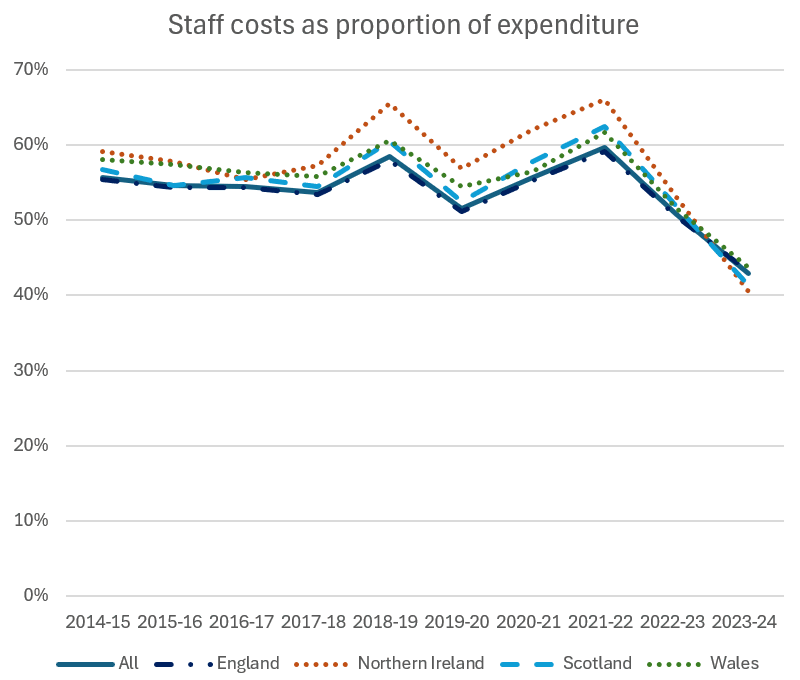
Plotting staff costs reported to HESA as a proportion of expenditure yields the following graph.
Figure 1. Staff costs as a proportion of expenditure, 2014-2024. Source: HESA.
Note. It has been suggested that some of this fall may be due to universities (improperly) reporting pension liabilities to HESA under the ‘staff costs’ heading. But if that were true, then staff costs were exaggerated in the past, because pension liabilities are not expenditure.
Either way, there is money in the sector to increase pay and save jobs.
4. Pay is falling sharply in real terms
As a result of below-inflation pay offers, pay rates (the value of each scale point in spending money) are now some 30% lower than 2008.
But the cut in rates of pay has become sharpest over the last four years. Since 2021, against RPI, staff on points 26 and above – the majority of UCU members – have had their pay cut by 15%. See Figure 2.
We are witnessing the steepest fall in the value of university staff pay in post-war Britain.
The Cost of Living Crisis is ongoing.
Figure 2. Index-linked pay rates as proportion of 2021 pay (RPI). Source: UCU negotiators.
Note. Even if you take the employer’s favoured CPI measure, the 15% pay cut becomes 9.5%. (In the interests of transparency, negotiators have even published a calculator so you can try out other measures.)
A 15% cut in pay is equivalent to working 55 calendar days a year (nearly two months) for the university for free, this year, and every year into the future. See Figure 3 below.
Pay cuts are pension cuts. So if our pay is cut by a third, our pension contributions are cut accordingly, and so is our pension in retirement.
Were the joint union demand on pay met, it would begin to turn this around, reducing the four-year pay cut to ‘only’ 9.5% in the worst case. For the lowest paid, it would return them to where they were four years ago.
An alternative way of visualising pay cuts is in terms of unpaid calendar days. This is the number of days a year the employer is not paying you, in 2021 money.
Figure 3. Cumulative pay cuts by scale point band since 2021, after adjustment for RPI. Source: UCU negotiators.
This year’s pay cut translates into a 3% cut against RPI, equivalent to 1 scale point on all grades, or requiring staff to work for the employer for free for 1.5 weeks for the rest of your employment.
With inflation expected to remain high, the imposed pay rate of 1.4% in Higher Education is far worse than in any other public sector comparable profession. For example, school teachers have been offered 4%, and in August it was reported that average pay increases are 4.7% excluding bonuses.
5. It is not “jobs vs. pay” – the employers are cutting both
This cut in pay has not stopped redundancies. We are not seeing savings spent on new jobs!
We are seeing escalating cuts in pay and mass redundancies in our sector.
UUK claim publicly “the sector” is in crisis.
Some universities are definitely struggling – and UCU says that should lead to targeted intervention from government(s). But Figure 1 shows this is only part of the picture.
Where is the money going?
Many universities are investing heavily in speculative ventures, such as overseas campuses, while making job losses.
Although rising borrowing costs may be a factor, official HESA data shows the biggest rise is in “other operating expenses”, which have jumped up by 50% in the last two years.
Universities are still splashing the cash – just not on staff.
This is not a question of “jobs vs. pay”. The employers are cutting both.
6. We need a UK-wide agreement on redundancies
This is why UCU is calling for ‘a national agreement to avoid redundancies, course closures, and cuts to academic disciplines.’
Whereas the detail of this is subject to negotiation, there are at least three clear steps the employers could agree to:
a moratorium on redundancies for a set period of time,
a nationally-agreed set of minimum standards of consultation when redundancies are made, in particular covering precariously-employed (‘casualised’) staff, and
a joint demand to government to address genuine financial crises, including bailouts of universities in deficit and to make progressive changes to the funding system.
It seems obvious that a combination of all three is needed, starting with a halt to redundancy programmes.
7. We need to stop #HiddenRedundancies
Escalating attacks on permanent jobs have been accompanied by an assault on precariously-employed posts, especially where staff are employed in teaching. These jobs have had many titles over the years, commonly called ‘HPLs’ (hourly-paid lecturers), ‘Associate Lecturers’, or ‘Visiting Lecturers’. These posts have one thing in common: the employer thinks they can dismiss them without notice when student numbers fall. And they often do exactly the same work as a lecturer with a permanent contract.
UCU refers to the redundancies of these ‘casualised’ staff as ‘hidden redundancies’. Commonly, employers fail to treat such staff lawfully, either because they select them unfairly for redundancy, or fail to consult them or the union at all. Often it arises by simply ‘failing to offer’ new work at the start of term, and then ‘offering them 0FTE’ or dismissing them. When the sector was expanding, such treatment was potentially unlawful bad practice (anyone with 2 years’ service can claim unfair dismissal and breach of contract). But this practice has escalated as employers have made redundancies of other staff. Partly because of this cavalier treatment, exact numbers are difficult to obtain, but they could be as high as 10,000 a year.
In the 2019-20 strike, UCU managed to get ‘casualisation’ onto the national bargaining agenda with UCEA for the first time. This was a major step forward. In some universities, like UCL and Open University, branches were able to use the UK-wide strikes to improve conditions. But the employers are not negotiating improvements, and are slashing jobs instead.
It is essential for staff with permanent contracts to defend colleagues in insecure positions. In 2022, Roehampton University sacked permanent staff and replaced them with fixed-term staff to teach out courses. If we don’t fight to secure the casualised, we allow the employer to casualise the secure. The employer will divide and conquer.
When we stand together we can win. Two days into Dundee UCU’s strike, the employer was forced to reinstate insecure staff it had summarily dismissed. Newcastle UCU demanded no redundancies of casualised staff as part of their strike, and won.
A national agreement to avoid redundancies must not exclude casualised staff. We have to make opposition to #HiddenRedundancies a central part of our campaign. First we need to win the ballot, and that means reaching out to casualised members everywhere.
8. We need to defend existing national agreements
Across the sector we are seeing serious attempts to undermine UK-wide agreements.
These have accelerated with the employer’s “crisis narrative” and are often combined with threats to jobs. Recent attacks include
Downgrading: Introduction of staff on Ac1 to work as lecturers, course leaders on Ac2, etc.
Workload: Attempts to compel staff to teach in the summer
Pensions: Outsourcing all staff and place them outside their pension schemes
Core terms: Threats to stop the principle of automatic incremental progression (undermining the Pay Framework Agreement)
Although these attacks are driven locally, once one university succeeds in doing this, the precedent becomes a threat to others.
UCU is saying enough is enough!
9. We stand with our sister trade unions
UCU is not challenging these attacks alone.
UCU is balloting alongside UNITE and UNISON branches, who are also in dispute with UCEA over pay. They share the same concerns over redundancies and national agreements. We are joined by our sister union, EIS, in Scotland.
We know that we are stronger together. If we all get over the ballot threshold we can speak with one voice to stand up for our sector.
So we call on every member to help us win the ballot.
10. We have not decided what action we will take – but we will do so democratically
This ballot asks questions on Strike Action and ASOS but does not specify the particular action UCU might ask its members to take.
So members have reasonably asked, OK, but what action is planned? What is the strategy?
This is a very important question. We refuse to be put in the same position as in the 2023 MAB, when a slim majority of the UCU HEC failed to call the reballot mandated by Sector Conference, allowing the employers to wait out the action.
But of course, there are many different forms of action that could be undertaken.
In the first place, we should say to members, that any strategy has to be flexible depending on changing circumstances. But we should discuss options.
For example, the action we might take may depend on whether the other trade unions are successful in their ballots. If all of the unions are successful in getting a mandate, the unions could call on all trade union members to strike together and shut down the whole sector. Such a strike will no longer be seen as a ‘lecturers’ strike’, but a Higher Education shutdown.
During the campaign, we should debate what actions we think we should take. Ultimately this is always a question of what members are prepared to do.
Whatever we decide, we need to run the action democratically so that every participant has a say.
We may wish to escalate or step down at certain points. The crucial question is not just what we decide to do but also who gets to decide?
The UCU Solidarity Movement is thoroughly committed to the view that we need to have the maximum democratic accountability throughout any action we decide to take.
That is why we have organised open rank and file meetings of union members every week for the last five years since Covid lockdown (excepting Xmas)! We practice what we preach.
We think the best way for any union to be held accountable to its members is through mass direct member involvement and control, not just by passing motions. In 2018, UCU members in pre-92 universities demonstrated this principle when they reversed a sell-out of the USS dispute.
Democracy is essential.
Watch: UCU reps in dispute on their strikes and the national ballot
First part of the meeting, dealing with the attack on pensions
Second part of the meeting, dealing with how we organise the fight back
Our pensions are under attack again
Universities UK (UUK) have published their initialproposalsfor the future of USS. Their proposals include:
Reduce the defined benefits salary threshold from £60k to £40k, which will significantly reduce benefits.
Reduce accrual rate from 1/75 to 1/85, cutting the value of future pensions by 12%.
Reduce inflation proofing from 10% to 2.5%, which will rapidly reduce our pensions when inflation goes up.
There is no need for this
USS assets have increased to £80 billion, and the scheme is able to pay current benefits from lower than current contributions for 30-odd years. USS’s claim that we must pay more, and receive less, is based on lies, and their attack on pensions now is worse than it was in 2018.
We have to be prepared to fight
Cuts always hit casualised members and lower paid members – those in the equality streams and younger members – the hardest. All of these changes are part of broader attempts to drive through the marketisation and privatisation of Higher Education.
We need to organise the fight back now
We can and we must win this battle. Industrial action will be needed again to stop the employers and USS, and to put political pressure on the Government and the Pension Regulator to protect our pensions. Attend this meeting of activists and join the fight back.
Speakers include:
Sam Marsh – USS national negotiator
Neil Davies – USS activist
Vicky Blake – UCU President
Sarah Joss – Vice President Heriot Watt UCU
Megan Povey – Member of National Dispute Committee
Carlo Morelli – UCU Scotland President
Marion Hersh – NEC and alternate negotiator
Tim Wilson – UCU National Dispute Committee and Vice Chair Dundee UCU
Fight to save our pensions! Fight for the future of higher education!
DB (defined benefits) salary threshold reduced to £40k. Currently we get DB for income up to about £60k. This would bring all but the lowest paid members into the Defined Contribution (DC) scheme, significantly reducing benefits and be a step to bringing back the DC scheme industrial action threw out in 2018.
Accrual rate reduced to 1/85 (currently 1/75) cutting the value of future pension by 12%.
Reduction in inflation proofing to 2.5%. Currently it is up to 10%. Inflation has been high in the past and could increase again. If it does our pensions could be very quickly reduced to only a fraction of their current value.
For all of their warm words and seemingly accepting UCU’s criticism of the valuation, the employers are now following USS’s lead and are attacking our pensions. Pensions are deferred pay and part of our contract of employment. We should not stand for this.
USS assets have increased to £80 billion and the scheme is able to pay current benefits from lower than current contributions for over 30 years. In their valuation, USS concocted a series of ‘lies, damned lies and statistics’ to present a sustainable and attractive pension scheme as a failing, unsustainable one.
Unless we fight it, USS and UUK are going to turn the valuation myth into a reality. Now the phoney war is over UUK have put their cards on the table. They are proposing a wholesale attack on the USS Defined Benefit (DB) scheme, worse than anything offered in 2018.
If these changes are implemented, it would end the USS Defined Benefit scheme. Members will pay more in than they will get out. They will leave en masse as the new scheme will be both unaffordable and not worth paying for and some will even leave the sector to look for better pensions elsewhere. This will create a genuine ‘death spiral’, a negative cashflow and the closure of the scheme. UUK may be hoping that this will lead to 100% DC being seen as the only alternative outcome.
We have to be prepared to fight. There are also massive equality issues. Cuts always hit casualised members and lower paid members – those in the equality streams and younger members – the hardest. UUK admit this by promoting ‘flexibility’, which in reality means an even lower-value pension offer for the lowest paid.
It is not just USS pensions under attack. Dundee University (pre-92) is threatening to close their local DB scheme for support staff, replacing it with a significantly worse DC one. At least five other post-92 universities are setting up subsidiary companies to employ new staff to avoid offering the (DB) Local Government Pension Scheme. This will also put the remaining public and private sector DB schemes at risk.
All of these changes are part of broader attempts to drive through the marketisation and privatisation of Higher Education, creating casualised pensions for an increasingly casualised workforce. We need to fight – for our own pensions and those of our colleagues and also for the pensions of the wider trade union movement.
We can and we must win
We stopped the UUK USS attack in 2018. The pension scheme survived, and members have had three more years of their pension as a result. But it took strike action to move the employers. Now industrial action will be needed again to stop the employers and USS, and to create necessary political pressure on the Government and the Pension Regulator.
Lobbying and campaigning will be necessary to complement industrial action. We will also need to negotiate but do so best from a position of strength due to industrial action. The urgent task for all of us is to prepare for strike ballots and action to defend our pensions.
The University of Liverpool is making 47 academic staff in Health and Life Sciences redundant in May 2021.
The rationale for these redundancies is based upon entirely bogus research metrics. The cuts are being driven by a cynical restructuring exercise under the cover of the pandemic. You can read more about the dispute here: www.hls47.co.uk
We are determined to stop this attack on jobs. The UCU branch voted by 90% in favour of industrial action. We will begin with action short of strike on 10th May, and three weeks of strike action will begin on 24th May, if the University does not take these redundancies off the table.
Join our rally to build solidarity and fight these cuts!
Speakers include:
Vicky Blake, UCU National President
Anthony O’Hanlon, University of Liverpool UCU
Noreen O’Sullivan, Liverpool Hope University UCU
Saira Weiner, Liverpool John Moores University UCU
Kevin Biderman, Royal College of Art UCU
John McDonnell, MP
Chair: Jo McNeil, University of Liverpool UCU
The attack on jobs at Liverpool is part of a wave of cuts spreading through universities. What happens at Liverpool will affect the confidence of other employers to push through cuts, so building solidarity for UCU Liverpool really matters.
Vicky Blake, UCU President, Ant O’Hanlon, Liverpool, Gabby Provan, Leicester, Brian Hamilton, UCU Prison Education, Margot Hill, Croydon College, FE, Federica Rossi, London South Bank University, Kevin Biderman, Royal College of Art, Umberto Albarella, Sheffield, Emma O’Dwyer, Kingston, and Tom Davenport, Aston
This Congress Fringe Meeting is called to raise solidarity for UCU branches in dispute over jobs, cuts, workloads, and health and safety. However, the best solidarity begins at home – we have to debate how we can unite the struggles to win. Fighting branch-by-branch is not sufficient.
The meeting will tackle issues such as winning ballots and taking industrial action during the pandemic, and explore the best ways to build solidarity for branches in dispute, to make sure they win!
The UCU Solidarity Movement is organising a second meeting on USS during UCU Congress – all welcome, you need not be a delegate to congress.
The Higher Education Sector Conference will only have a limited time available for discussion, and will focus solely on the motions and amendments tabled for debate. The UCU Solidarity Movement meeting will allow for a wider discussion on USS, and allow members and HESC delegates to consider at greater depth how to develop the UCU’s campaign to defend USS.
Speakers include:
Sam Marsh – USS national negotiator
Sarah Joss – Vice President Heriot Watt UCU
Tim Wilson – UCU National Dispute Committee and Vice Chair Dundee UCU
Marion Hersh – NEC and alternate negotiator
Candidates standing for election as USS negotiators are encouraged to join the meeting, to speak and/or field questions.
Please share the event widely among your networks and on social media, and make sure your UCU branch is represented at the meeting.
10 FE colleges open their industrial action ballots on Monday 14th June 2021 in disputes over pay and conditions. Lunchtime protests have been called at 12:30pm on Tuesday 15th June.
A physical socially-distanced rally will be held at City & Islington College at 12:30pm
Speakers include Jo Grady, UCU General Secretary
Register for the London Region zoom meeting to link up the protests
We have been through a lot in the last year. We moved mountains to ensure that our students get the education they deserve. In the last few weeks, we have been working even harder than usual at this time of year, to meet assessment deadlines.
Unfortunately, our going the extra mile to ensure that our students are awarded their qualifications has not been recognised. Management have cynically launched restructures, placed a number of our colleagues in redundancy pools, proposed new draconian observation policies, and cut our wages.
Why is it whenever managements fail to do their very well-paid jobs effectively, it is the front-line staff who are made to pay for their mistakes?
Show your solidarity with the FE UCU members by joining our live and online protest at 12:30pm on Tuesday 15th June 2021. Please share details widely.
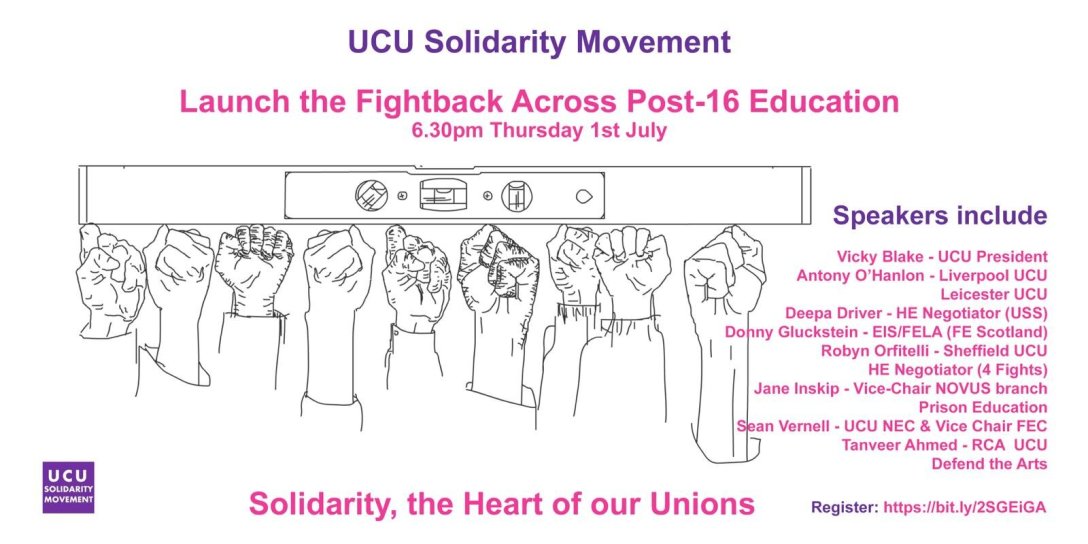
Campaign rally organised by the UCU Solidarity Movement
6:30pm Thursday 1st July 2021
The fight against job cuts at Liverpool and Leicester universities has reached a crucial stage. After recent strikes, members of both branches are now taking part in marking and assessment boycotts as part of their campaigns. Management at Liverpool have announced that they are imposing 100% pay docking on all staff who participate.
Meanwhile, there is now a real prospect of a fightback that can unite the entire union membership in defending the whole post-16 education sector.
Strike ballots over pay and conditions in 20 FE colleges are ongoing. And the decisions from Congress and sector conferences mean that universities are relaunching the Four Fights dispute and preparing for a fight in defence of USS pensions.
On 2nd July, the HE Committee will discuss how to implement this mandate. UCU’s policy is to launch industrial action ballots across pre- and post-92 HE as well as FE, at a time when members in prisons and in Adult Community Education are standing up against cuts.
We are on the verge of a potential co-ordinated struggle for the future of the post-16 sector, in which we can lead the trade union movement to defend education. We now need to organise to ensure we can deliver united cross-sectoral action.
The UCU Solidarity Movement has therefore called a rally on Thursday 1st July to highlight these issues and other initiatives such as the campaign in Defence of the Arts, as well as providing an opportunity for UCU branches to build solidarity for local disputes.
Speakers include:
Vicky Blake – UCU President
Ant O’Hanlon – University of Liverpool UCU
Deepa Driver – USS Pensions Negotiator
Jane Inskip – Vice Chair of Novus branch – prison education
Robyn Orfitelli – University of Sheffield UCU
Sean Vernell – UCU NEC and Vice Chair of the Further Education Committee
Tanveer Ahmed – Royal College of Art UCU
Donny Gluckstein – EIS FELA – Scottish further education
Plus speakers from Liverpool and Leicester UCU branches
Please circulate this notice among colleagues, share the details on social media, and ensure your branch is well represented at the rally.
We are planning a Twitter Storm between 1:00pm and 2:00pm on Thursday to publicise the Rally. Please be prepared to tweet and quote retweet messages on your Twitter. Use the hashtag #UCUFightsBack and include the signup link in your scheduled tweets.
This event is for all across post-16 education. If you would like to help build the event or get involved in the UCU Solidarity Movement, please join our next planning meeting at 6pm on Wednesday 30th June.
It’s Our University! On the 9th of July 2021, we will digitally gather together with our friends from the School of Languages and Culture and supporters both local and global (ahead of the council meeting on the 12th) to help stop the sweeping attack on the Arts and Humanities perpetrated by the administration of the University of Sheffield, which is bringing about a rising wave of redundancies, underfunding and closures.
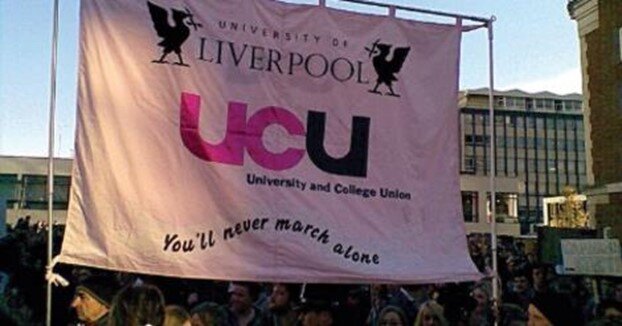
Meet at the famous Bombed Out Church, Berry Street, Liverpool city centre
This demonstration has been called by UCU University of Liverpool and TUC Liverpool, to highlight the fight for jobs in the city, including those at the university. Fire and Rehire fights, such as Manchester bus drivers, have been won by determined action. We need to build on these and other successful union actions throughout the trade union movement, and fight for all jobs.
At the University of Liverpool, 47 teachers and researchers in the Faculty of Health & Life Sciences were due to be made redundant this summer, but industrial action by UCU members has reduced this number to 21. We are determined to save every job, through strikes, working to contract, a marking & assessment boycott, and protests.
The solidarity shown by other trade unionists and activists has been crucial to building our members’ confidence and supporting the campaign. We invite you to join us at this in-person, socially distanced demonstration through Liverpool, and help us to show the university that we will remain defiant.
Please wear a mask if you can, bring your union banners, home made placards and posters, and share this event widely with friends and colleagues.









 UCU Solidarity Movement